
You’re right to wonder—most coffee scoops hold exactly 2 Tbsp, which is about 10 g of ground coffee. That volume works with the classic 1:16 coffee‑to‑water ratio, giving you a balanced cup when you brew 6 oz of water. If you level the scoop and double‑check with a kitchen spoon, you’ll see the consistency; next, you can tweak the dose or scale up for larger mugs or a French press.
Define the Standard Coffee Scoop: 2 Tbsp
What exactly is a “standard” coffee scoop? You’re probably wondering why recipes keep saying “one scoop” and yet you see different sizes on shelves. Here’s the thing: the standard scoop measures 2 tbsp, which equals 6 tsp, 1/8 cup, about 30 mL, or one fluid ounce. Historically, scoop design began in the early 1900s when baristas needed a quick, repeatable measure, and the 2‑tbsp volume stuck because it balances flavor and convenience. Regional variations exist—some European scoops tilt toward 10 g of coffee, while U.S. versions focus on volume, but they all aim for roughly the same brew strength.
Now, you can trust that a level scoop holds about 10 g of ground beans, give or take a gram depending on bean density. The takeaway: regardless of brand or region, the “standard” scoop means 2 tbsp, so you can consistently brew a cup without guessing. Next, ask yourself how many tablespoons that scoop actually holds.
Most baristas recommend using a standardized weight of 7–8 grams for a single cup to ensure consistent extraction.
A well‑balanced cold brew concentrate typically uses a 1:4 coffee‑to‑water ratio, which can be measured precisely with a standard coffee scoop.
The optimal scoop amount can also depend on the brew strength you prefer, allowing you to fine‑tune flavor without changing the equipment.
Verify How Many Tablespoons Your Scoop Actually Holds
You’re probably wondering if that “standard” scoop really holds two tablespoons or if it’s a bit off.
Does your scoop match the 2‑Tbsp rule?
Now, grab a kitchen tablespoon, fill it with water, and pour it into the scoop twice. If the water fits perfectly, the scoop texture aligns with the industry norm and you’ll get consistent grind consistency. If not, the scoop may be non‑standard, so you’ll need a measuring spoon set for a direct comparison.
How do you check level versus heaped fill?
All right, level the scoop’s edge with a flat utensil before measuring. A leveled scoop gives a true volume, while a heaped one inflates the reading and throws off your brew.
What’s the next move?
Obviously, repeat the water test a couple of times to confirm repeatability, then move on to weight verification if you want gram‑exact dosing. This quick check saves you from under‑ or over‑extracting coffee.
Regular descaling prevents mineral buildup that can affect scoop accuracy over time.
You can also try a shaking technique by placing warm milk in a tightly sealed jar and shaking vigorously to create foam, which demonstrates how air incorporation can alter volume measurements.
Choosing the correct cup size, such as a demitasse cup of roughly 2 oz, helps ensure your espresso volume matches the intended dosage.
Convert Scoop Tablespoons to Grams (The 10‑Gram Rule)
A coffee scoop that holds two tablespoons often feels like a magic number, but you’re probably wondering how many grams that really is. The 10‑gram rule says a full scoop equals roughly 10 g of ground coffee, because one tablespoon packs about 5 g. Now, scoop density matters: lighter beans or a coarse grind will sit near the lower end, while a fine grind packs tighter and pushes the weight toward 12 g. Grind texture also shifts the number—finer textures increase mass per volume, so you might need to level the scoop to stay close to 10 g.
How does the rule work for you?
You start with the 2‑tablespoon baseline, then adjust for bean density and grind texture. If you notice your coffee tastes weak, try a slightly heaping scoop or a finer grind to add a gram or two. Conversely, a bitter brew may signal you’re over‑loading the scoop.
Takeaway: The 10‑gram rule is a solid starting point, but tweak it based on scoop density and grind texture for consistent flavor. Next, consider how that weight translates into the 1:16 coffee‑to‑water ratio.
Particle size influences extraction efficiency and flavor balance, and using the optimal coffee‑to‑water ratio ensures a balanced brew.
Choosing the right grind for your brewing method can dramatically affect the extraction yield and overall taste.

Durable and rust-resistant - Made of 304 stainless steel, this measuring spoon is built to last and resist corrosion from extended use.
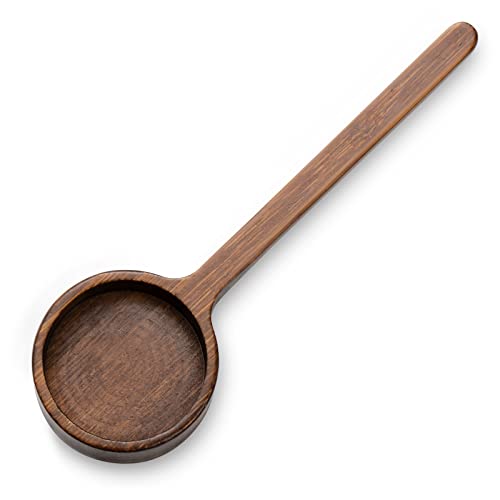
Product Compatibility and Style: Compatible with coffee jars, glass spice jars, and farmhouse minimalist food jars, enhancing the overall kitchen aesthetic.

10g Espresso Precision in One Tool Measure coffee and water simultaneously – 10g powder + 30ml water for perfect espresso every time.
Apply the 1:16 Coffee‑to‑Water Weight Ratio Using Scoop Tablespoons
If you’re wondering how a 2‑tablespoon coffee scoop fits into the 1:16 coffee‑to‑water ratio, you’re asking the right question.
How do I match water to a scoop?
You start with scoop calibration: a level 2‑tablespoon scoop holds about 10 g of grounds. Multiply 10 g by 16 and you need roughly 160 g (or ml) of water. Using a kitchen scale for the water guarantees brew consistency, even if your scoop isn’t perfectly level each time.
What if I use more than one scoop?
Just double the coffee weight, double the water weight. Two scoops give 20 g coffee and 320 g water, preserving the 1:16 ratio. The linear scaling keeps extraction steady across single cups or larger batches.
Takeaway: Treat your scoop as a repeatable coffee unit, weigh the water, and you’ll achieve reliable, consistent brews every time. Next, you might wonder how adjusting the scoop size changes strength. Adding a cold brew step after grinding can further enhance flavor clarity. Using a burr grinder ensures uniform particle size, which is key for consistent extraction. Proper water temperature control during brewing also helps avoid under‑ or over‑extraction.
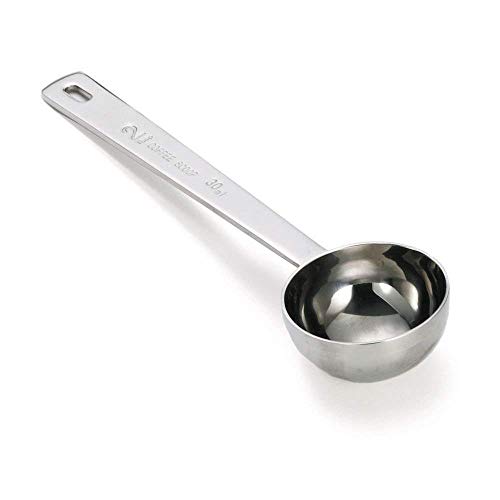
2 tablespoon coffee scoop: 30 ml capacity for measuring ground coffee, coffee beans, tea powder, sugar, baking powder, baking soda, spices, and condiments.

Make the most of POP Containers with all-new POP Accessories; seven solution-based tools that attach neatly to the underside of Container lids

☕️ One-Handed Efficiency: The coffee scoop allows you to scoop, level, and fill reusable K Cups in one motion—perfect for busy mornings. No tool switching needed.
Adjust Brew Strength: 1 Tbsp vs. 2 Tbsp per 6 Oz Water
How does the amount of coffee per 6 oz water change the cup’s strength? You’re probably wondering why a single tablespoon feels so different from two. Here’s the thing: 1 Tbsp per 6 oz yields a lighter strength, about 5 g of grounds, giving a milder flavor balance. It’s the low end of the range, perfect if you like a gentle sip.
All right, bumping up to 2 Tbsp (≈10 g) doubles the dosage consistency and pushes the brew to a medium‑to‑stronger strength. The extra coffee extracts more oils, sharpening flavor balance and body. Your brewing method—drip, pour‑over, or French press—will still tweak perception, but the tablespoon count remains the main driver.
Bold extraction from a percolator can be achieved with a higher dose, but the French press offers a smoother cup at the same ratio.
Obviously, the key is consistency: use the same scoop size each time, or weigh the grounds, so you can repeat the exact strength you love.
Takeaway: 1 Tbsp = mild, 2 Tbsp = robust; choose based on your taste and keep the dose steady. Next, think about how to scale this for larger mugs or a carafe. Consistent ratio ensures repeatable flavor. Using a coarse uniform grind helps prevent over‑extraction when increasing the dose. Adding a nitrogen infusion step can further enhance the mouthfeel and create a silky texture.
Scale Scoop Tablespoons for Larger Mugs, Carafes, and French Presses
Ever wonder why your 12‑oz mug needs twice the coffee of a 6‑oz cup? You’re spot‑on: scoop sizing drives brew consistency, and the math is simple. One scoop equals two tablespoons, about ten grams. For a 12‑oz mug, use two scoops (four tbsp). A 16‑oz mug steps up to 2.5–3 scoops, depending on strength.
How do I scale for a carafe? Multiply the per‑cup dose by the total water volume. If a full carafe holds 1 L, aim for roughly 100 g coffee (10 g per 100 ml). Weight‑based scaling keeps brew consistency across batches.
What about a French press? Use two scoops per six oz of water, then adjust proportionally. A 32‑oz press needs about four scoops (eight tbsp).
Takeaway: Match scoops to water, keep the 1:15‑1:18 ratio, and you’ll hit consistent flavor every time. Ready to measure by weight for perfect results? The importance of uniform particle size is crucial for extracting balanced flavor. The espresso‑like pressure of a Moka Pot can also be simulated with a finer grind in a French Press for a richer body. Understanding the brew ratio helps you fine‑tune strength across different brewing methods.

Durable and attractive stainless steel construction for longevity

Packing: This set includes 4 stainless steel coffee scoops, each measuring 5.9 inches/15cm in length. With a capacity of 15ml, these measuring spoons are perfect for accurately measuring the amount of coffee grounds. They are extremely useful in the kitchen, allowing you to store them in various containers for different types of coffee, loose tea, protein powder, and more. With these scoop, you can ensure a consistent and delightful drinking experience.

TABLESPOON CAPACITY – Each tablespoon measuring spoon holds 1 tbsp or 15 mL, making it easy to portion coffee grounds, protein powder, spices, tea, and baking ingredients.
Understand Common Scoop Size Variations and How to Stay Consistent
Why do coffee scoops feel different from one brand to another? You’ve noticed scoop variations and wonder why the same “standard” label doesn’t guarantee identical volume. Here’s the thing: manufacturers change the shape, depth, and rim width, so a scoop that reads 2 Tbsp in one pack might hold 1.5 Tbsp in another. Grind density adds another layer—coarse beans occupy more space than fine grounds, so the same volume can weigh anywhere from 10 g to 12 g.
All right, to stay consistent, pick one scoop and use it every brew. Level it off each time; a heaping scoop adds up quickly. If you switch beans or roasts, weigh the coffee; a digital scale eliminates guesswork caused by grind density.
Takeaway: control volume with a single, leveled scoop or, better yet, use weight for precision. Next, ask yourself whether you need a quick 2 Tbsp rule or a scale for exact flavor control.
If you need a temporary filter, a paper towel can serve as an emergency coffee filter, though it may affect flavor and durability.
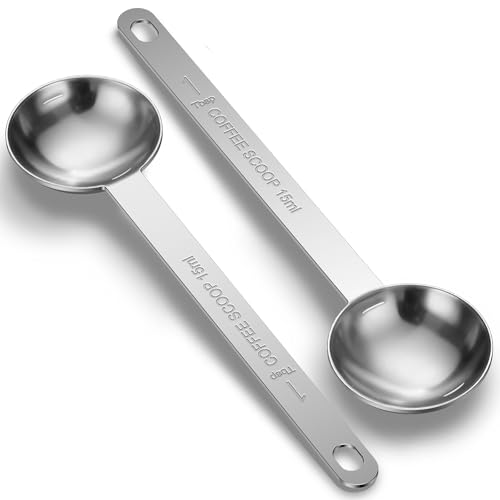
Precise Coffee Measurement: Each coffee scoop spoon holds 15ml (1 tablespoon), ensuring consistent coffee-to-water ratio for perfect brews every time. Ideal for coffee, tea, or baking essentials.

【Premium Quality】Our coffee scoop is made of food grade 304 stainless steel with mirror polished finish, no sharp edges, durable, not easy to rust, will not absorb the smell of coffee. The stainless steel of the coffee scoop is 2mm in thickness, so it won't break or deform easily. And it is easy to clean, dishwasher safe

Coffee Scoop with Leveling Funnel: Our coffee scoop features a leveling funnel design for easily measure up to 2 tablespoons, making it easy to refill reusable K-cup pods
Why 2 Tbsp Works for Most Brewers (Volume, Weight, and Flavor)
Ever wonder why most coffee guides settle on a 2‑tablespoon scoop? You’re not alone; the 2 Tbsp rule balances volume, weight, and flavor for everyday brewers. Two tablespoons of ground coffee weigh about 10 g, which pairs nicely with a 1:16 coffee‑to‑water ratio, so a 6‑oz cup gets roughly 60 g of water. That ratio hits the sweet spot for flavor extraction—neither thin nor overly bitter—across typical brew temperatures (195‑205 °F).
How does grind size fit?
A medium grind lets water flow evenly, letting the 2 Tbsp dose extract uniformly. Finer grinds can over‑extract, while coarse ones under‑extract, shifting the balance.
What’s the practical takeaway?
Start with 2 Tbsp, adjust brew temperature or grind size if needed, and you’ll hit a consistent, tasty cup every time. Ready to experiment with your next brew? Uniform grind size is key for predictable extraction.

Color: Red Constructed with durable BPA-free plastic this coffee ground scooper is made to last and it s top-rack dishwasher safe for a quick and easy clean up.

Package Included: You will receive 2 coffee scoop 2 tablespoon, each measuring 4.72"L * 1.96" W * 1.18" D and 30ml.

GET THE RIGHT MIX - Brew the perfect cup of coffee every morning. Our set comes with 1 tbsp (15 ml) and 2 tbsp (30 ml) coffee scoops, so you can get the right amount of coffee every time.