
You’re probably wondering how many scoops to put in your French press, and the answer depends on size and strength. For a standard 8‑cup (≈1 L) press, aim for 6–7 level scoops (≈60‑70 g) to hit the classic 1:15 ratio; a 4‑cup press needs about 3 scoops, and a 12‑cup press about 9‑11 scoops. Adjust half‑scoop increments for light, balanced, or bold brews, and you’ll get consistent flavor every time—next, you’ll see how grind size and bloom affect the result.
The Ideal French Press Coffee‑to‑Water Ratio (1:15)
What’s the right coffee‑to‑water ratio for a French press? You’re probably wondering why 1:15 keeps popping up. Here’s the thing: the ideal ratio means one gram of coffee for every fifteen grams of water, giving a bold, balanced cup that’s richer than drip.
How does grind size fit in? Use a coarse, even grind so water flows smoothly and avoids over‑extraction. Too fine, and you’ll get sludge; too coarse, and the brew turns weak.
What about water temperature? Aim for 195‑205 °F (90‑96 °C). That range extracts oils without scalding the beans.
And brewing time? Let the coffee steep for four minutes, then press slowly.
Takeaway: stick to 1:15, coarse grind, 200 °F water, and four‑minute steep for a solid French press. Next, you might wonder how to convert spoons to grams. Consistent weighing ensures repeatable results. Adding a bloom phase before the full pour helps release trapped gases and improves flavor extraction. A proper pre‑heat of the press helps maintain temperature stability throughout brewing.

One 10 oz bag of Gevalia Guatemalan Single Origin Special Reserve Coarse Ground Coffee

CRAFTED FOR FRENCH PRESS BREWING: Coarsely ground specifically for the slower immersion brewing process of French press coffee makers; larger grind size ensures balanced flavor extraction without bitterness, yielding a rich, full-bodied cup
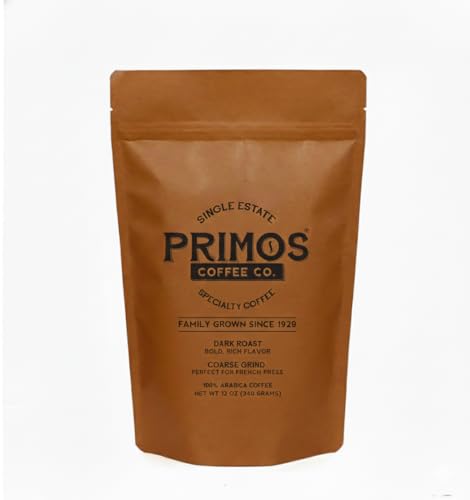
CRAFTED FOR FRENCH PRESS BREWING: Coarsely ground specifically for the slower immersion brewing process of French press coffee makers; larger grind size ensures balanced flavor extraction without bitterness, yielding a rich, full-bodied cup
Convert French Press Coffee Tablespoons to Grams
How many grams are in a tablespoon of French‑press coffee? You’re probably wondering why the numbers shift, and the answer lies in density density conversion and grind density. A level tablespoon of medium‑coarse press usually weighs about 5 g, but a heaping spoon can hit 6 g because the grounds pack tighter. If you use a standard 2‑tablespoon scoop, expect roughly 10 g, though some guides list 10.6 g due to subtle density differences.
The brew strength can be fine‑tuned by adjusting the scoop size to match your taste preferences.
Now, let’s translate that to your 32‑ounce press. Six tablespoons become 30 g, but many French‑press recipes cite 42‑56 g for the same volume, reflecting how grind density and roast level affect the mass. The takeaway: start with the 5 g‑per‑tablespoon rule, then adjust by taste and the specific grind you use. Next, consider how many scoops your press size calls for.
A standard coffee scoop typically holds about 1 to 1½ tablespoons of ground coffee. standard scoop capacity helps ensure consistent brewing across different beans.

Dual-Functionality Design: The Frieling Coffee Spoon & Stirrer combines the utility of stainless steel measuring spoons with the effectiveness of a french press spoon. Its elegant construction makes it an essential tool in every coffee-making ritual

PRECISE COFFEE MEASURING FOR THE PERFECT BREW Ensure a consistent and flavorful cup every time with this 2-tablespoon coffee scoop. Designed for accuracy, it helps achieve the ideal coffee-to-water ratio for espresso, pour-over, French press, and drip coffee.

Premium Quality: This measuring cup coffee spoon is made of food grade stainless steel, which is safe, non-toxic and tasteless. The surface is polished, shiny, not easy to fade or rust, easy to clean, strong workmanship, long-lasting.
Scale French Press Coffee Scoops by Press Size (3‑Cup – 12‑Cup)
If you’re wondering why a 3‑cup press needs only a couple of scoops while a 12‑cup jug calls for double‑digit scoops, you’ve hit the right question. A 3‑cup press (≈300 mL) takes about 1.5 – 2.5 scoops for light to strong brews. A 4.5‑cup (≈600 mL) steps up to 3 – 4 scoops. An 8‑cup (≈1000 mL) needs 6 – 7 scoops, and a 12‑cup (≈1500 mL) climbs to 9 – 11 scoops.
How does brew size affect scoop count?
Now, each jump in brew size roughly doubles the coffee volume, so you double the scoops. The grind stays coarse, and you keep brew temperature around 195‑205 °F for optimal extraction. The mesh filter in a French press separates the grounds from the liquid, ensuring a clean cup. Proper water temperature is essential for extracting the coffee’s full flavor without bitterness.
What’s the practical rule?
All right, start with the listed scoop range for your press size, then adjust by taste. The takeaway: match scoops to press capacity, keep a consistent grind and temperature, and you’ll hit the sweet spot every time. Next, explore how those numbers translate to light, balanced, or bold strength. For a balanced cup, aim for a 1 gram‑to‑15‑grams coffee‑to‑water ratio.

Wash in warm, soapy water before first use and dry thoroughly

Superior Filtration: A solid filtration system in a coffee maker ensures a refined taste and robust flavor mouthfeel. Our 4-filter sieve system has an improved piston plate and 80 mesh filter that extracts the earthy, rich taste of residue-free coffee. This 1000 ml/34 Oz beaker makes 4 cups of creamier & tastier coffee.
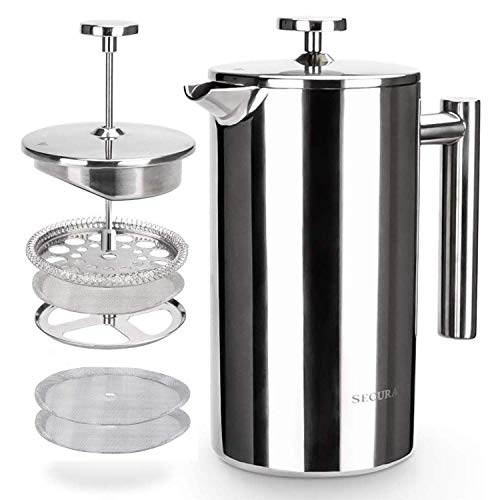
Secura stainless steel French Press coffee maker is made from top quality 18/8, 304 stainless steel, both the interior and exterior. It is made to outlast other coffee makers
Adjust French Press Coffee Scoops for Light, Balanced, or Bold Strength
You’re probably wondering why the same 16‑oz press can give you a light, balanced, or bold cup just by tweaking the scoop count. The trick lies in scoop variations and brew temperature. Light strength uses about 2.5 scoops (≈25 g) with a 1:17 ratio; you’ll notice a milder flavor and a slightly cooler brew, around 190 °F.
All right, balanced coffee hits 3 scoops (≈30 g) at a 1:15 ratio; most people brew at 195‑200 °F, giving a full‑bodied, steady cup.
Here’s the thing: bold strength steps up to 3.5‑4 scoops (≈35‑40 g) for a 1:12‑1:14 ratio, and you’ll want brew temperature near 200‑205 °F to extract those robust notes.
Takeaway: adjust scoops by 0.5‑1 g increments and match brew temperature to the desired strength. Next, test a single change and note the taste shift. For consistent results, follow the ideal coffee‑to‑water ratio and time each step precisely. The mesh plunger separates the grounds from the liquid, ensuring a clean pour. A cold brew can also be made using the same scoops for a smoother, less acidic alternative.
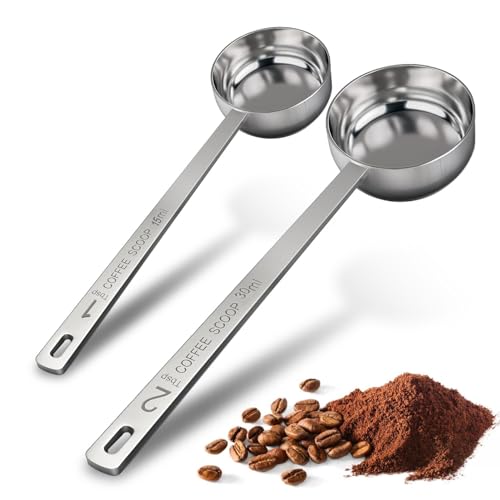
Premium Stainless Steel Coffee Scoop Set: Durable 2PCS Stainless Steel Coffee Scoop Set Includes 1 Tbsp (15ml) And 2 Tbsp (30ml) Coffee Measuring Spoons - Perfect For Accurately Scooping Ground Coffee, Tea, Protein Powder, And Spices

WOODEN SPOONS THAT FEEL AS GOOD AS THEY LOOK – Crafted from rich padauk wood, each long spoon is professionally sanded for a silky-smooth finish that stirs and scoops with ease while elevating your kitchen style.

EVERYTHING YOU NEED TO BREW BETTER COFFEE – Start brewing exceptional French press coffee right away with a thoughtfully curated kit that includes a 34 oz (1000ml) double-wall stainless steel French press, coffee scoop, extra-long stirring spoon, leather trivet, BREVIK Fresh coffee bag clip, and stainless steel Master Brew Guide reference card.
Common French Press Coffee Scoop Mistakes & How to Fix Them
When you’re juggling different scoop sizes, it’s easy to miscount coffee by volume instead of weight, and that throws off every brew. You might think a level tablespoon always means the same grams, but density shifts with roast, bean shape, and grind. Use a kitchen scale for true scoop consistency and ignore the vague “cup” label on your press.
Why does the wrong scoop hurt?
A 34‑oz press isn’t four 8‑oz mugs. If you overfill grounds, sludge clogs the filter and plunging gets tough. Under‑filling yields weak coffee even when water fills the chamber. Match scoops to actual water weight, not marketing size.
What about grind uniformity?
Coarse, sea‑salt‑like particles pack loosely; fine grinds squeeze more weight into the same scoop, causing bitterness and sludge. Switch to a burr grinder for even particles, then keep your scoop count steady.
How to fix the bloom issue?
Pour water slowly, stir gently, and let the coffee bloom for 30 seconds. This evens saturation, preventing sour spots and bitter patches.
Takeaway:
Weight‑based scoops, proper grind, and careful blooming give repeatable flavor. Next, ask yourself how many grams of coffee match your water volume for the perfect strength. Cold brew offers a smooth, low‑acid flavor that can be achieved with the same precise scoop measurements.
A slightly longer steep time, such as four minutes, can deepen body without risking over‑extraction.
Adding a precise measurement step, like checking the optimal coffee‑to‑water ratio, ensures consistency across different beans and roast levels.
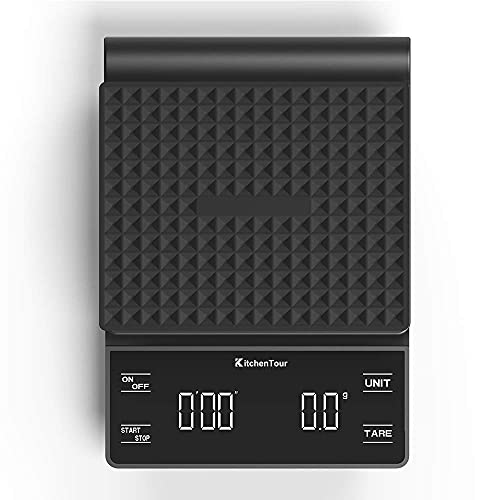
PRECISE MEASUREMENT & WIDE RANGE: KitchenTour EK6002 defines the latest in precision weighing technology with a weight capacity from 0.3g - 3000g to help you measure and get an exceptional cup of coffee with refined accuracy

Digital kitchen scale with food-safe, BPA-free plastic components

Contemporary Slim Design: Made of Stainless Steel Material; It is easy to use and clean; Provides accurate weight data with a user-friendly control panel and system; With high precision sensors to ensure correct performance and readouts
Your Handy Cheat Sheet: Scoops, Tablespoons, and Weights
You’ve probably wondered how many scoops actually equal a tablespoon or a gram, and why those numbers matter for a French press. A standard coffee scoop holds about 2 tablespoons, roughly 10 g of grounds. That means one tablespoon is about 5 g, and you can convert any recipe by halving or doubling the scoop count.
How many scoops for my mug?
For a 6‑8 oz mug, aim for 1.5–2 tablespoons, so use ¾–1 scoop. Keep the grind coarse; consistency prevents over‑extraction.
What about a larger press?
A 32‑oz (4‑cup) press needs about 8 tablespoons—4 scoops. A 1‑liter press uses 60–70 g, roughly 6–7 scoops.
Takeaway
Use the 2‑tablespoon‑per‑scoop rule, measure level, store scoops dry, and maintain grind consistency. Next, try weighing your first brew to see how the 1:15 ratio feels. Regularly descale the machine to prevent mineral buildup that can affect water temperature and extraction quality. Understanding brew ratio helps you fine‑tune flavor across different methods.