
You’re probably folding your Chemex filter flat, which collapses mid-brew and muddies your cup. Here’s what you actually do: fold it in half, then half again, then open it gently into a cone shape with the triple-layer side facing the spout. That thick reinforcement seals against the spout so water doesn’t sneak around edges. Wet it with hot water before brewing to eliminate papery taste and lock everything in place. Get this right and you’ll notice cleaner, brighter coffee immediately.
Choose Square or Circular Chemex Filters
You’re probably wondering whether square or circular Chemex filters actually matter—and honestly, that’s the right question to ask.
Here’s the thing: they brew virtually identically. No meaningful taste difference exists between the two when you use them correctly. The real distinction comes down to handling convenience, not flavor.
Square filters shine during cleanup. Those corners rise above your carafe, making them easier to grab and remove without burning your fingers. Circular filters require correct orientation against the spout, which takes a bit more attention during setup.
Both styles achieve the same clean cup through Chemex’s bonded paper. Your choice depends on what feels natural in your hands, not extraction quality.
Think about your morning routine. Do you value speed during removal, or does setup simplicity matter more to you?
A thorough rinse pre‑rinse helps prevent residual coffee oils from affecting flavor. The Chemex’s thick paper filter produces a clean, bright cup with minimal sediment. Adding consistent water temperature ensures the extraction remains balanced.

PURE: The cone shape of all CHEMEX filters ensures uniform extraction for pure coffee flavor in every brew

Step 1: Fold the CHEMEX filter in half. Then fold in half again, bringing the two corners together. Place your finger between the 3rd and 4th layer and open into a funnel.

PURE COFFEE FLAVOR: The signature cone shape ensures uniform saturation and extraction for a clean, balanced, sediment-free pour over cup every single time
Fold Your Filter Into a Stable Cone
How do you actually fold a flat piece of paper into something that holds water without collapsing?
Start by folding your filter in half, then fold again to bring opposite corners together. Now open it slightly so the creases naturally form a cone shape—you’re not flattening it, you’re creating overlapping layers that taper toward a point.
Here’s the thing: those pre-existing creases on Chemex filters aren’t just decorative. Match your folds to them for cone shape stability. Place your finger between the third and fourth layers at the base to create a small funnel opening.
Press those folded edges firmly. Crisp paper creasing locks everything in place and prevents the cone from shifting under its own weight. The result? A symmetrical, stable structure ready for wetting. Using a uniform particle size grind helps ensure consistent extraction when brewing with a Chemex. The high‑pressure extraction of espresso contrasts with the longer steeping time of a French press, highlighting how different brewing methods affect flavor and caffeine concentration. A proper water temperature is essential for optimal extraction.
Position the Thick Side Over the Spout
Now that you’ve got your cone holding its shape, there’s one more detail that stops most people cold: which side actually faces the spout?
The thick, triple-layer side goes directly over the opening. This isn’t arbitrary—it’s about filter rigidity and durability where you need it most.
Here’s the thing: when hot water hits wet paper, that spout area wants to collapse inward. The extra layers give you structural support exactly where your filter is most vulnerable. You’re fundamentally reinforcing the weakest point.
Better spout sealing also means cleaner drainage. When the thick side sits snugly against the glass near the opening, water flows through your coffee bed instead of sneaking around the edges. You’ll get more consistent extraction and fewer surprises mid-brew.
Ready to rinse and load your grounds?
The temperature water pressure of an espresso machine must be carefully regulated to avoid over‑extraction.
A standard coffee scoop typically holds 7–8 grams of ground coffee.
Using an unbleached paper towel as a temporary filter can introduce chemical residues that affect flavor.
Rinse and Prime Your Filter With Hot Water
Before you add a single ground, you’ve got to rinse that filter—and it’s not just a rinse-for-the-sake-of-it kind of step.
Why This Matters
Those thick Chemex filters shed papery flavors that’ll end up in your cup if you skip this. You’re also preheating the glass vessel, which prevents your brew temperature from dropping the moment hot water hits cold glass.
The Process
Place your folded filter in the Chemex. Pour hot water slowly over the entire paper surface, saturating the seams completely. Let it drain fully—don’t rush it.
Now dump that rinse water out. Your filter stays seated and ready.
You’ve eliminated paper taste, warmed your brewer, and set yourself up for consistent extraction. That’s the foundation everything else builds on. Regularly descaling the machine with a citric‑acid solution helps maintain optimal water flow and prevents mineral buildup. Proper water hardness management also protects the machine from scale buildup and ensures a clean taste. Using a tight‑seal jar can quickly create frothy milk for a richer crema if you like a milk‑based coffee twist.

PURE COFFEE FLAVOR: The signature cone shape delivers uniform saturation and extraction for a clean, balanced, sediment-free pour over cup every single time

Upgraded Thickness & Purer Taste: The paper process has been completely upgraded, increasing the paper thickness by 30%, resulting in more even fiber distribution and finer filtration. Our next-generation paper coffee filters are engineered with 100% premium Canadian pulp and advanced fiber distribution. Effectively trap excess oils, fine sediment, and bitter particles. Experience a cleaner, smoother cup with our next-gen filters.
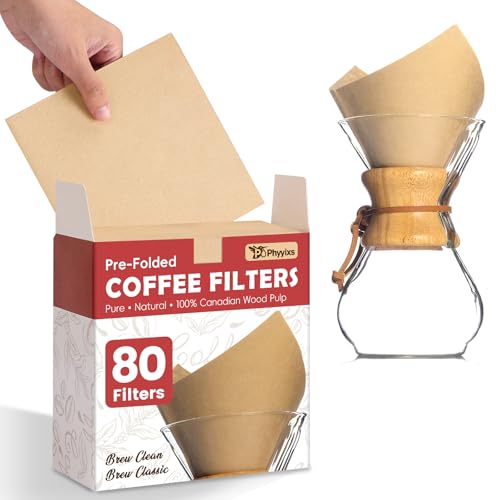
【Premium Long-Fiber Paper for Clean, Balanced Flavor】 Crafted from long-fiber pulp imported from Canada, Phyyixs filters feature a dense, uniform structure that promotes steady flow and even extraction. The result is a clean, well-balanced cup with reduced sediment and no harsh bitterness.
Prevent Collapse, Stalling, and Uneven Extraction
Once your filter’s rinsed and your Chemex is warm, you’ve got to position that paper just right—because a poorly seated filter’ll collapse, choke off your flow, or let water rush through unevenly and ruin your brew.
The three-layer side of your folded filter belongs against the spout. This thick wall creates paper stability and acts as your flow‑control point, maintaining airflow between the paper and brewer wall. That air gap prevents vacuum lock from forming—the killer that stops drawdown cold. The pre-folded middle line serves as your alignment guide to ensure the three-layer side faces the correct direction.
Your cone should sit evenly without twisting or bunching. Don’t let the paper touch too much of the brewer’s inner wall; excessive contact slows drainage and invites collapse. A stable, properly positioned filter preserves your coffee bed’s shape throughout the entire brew, delivering consistent extraction and the clean cup you’re after.
Choosing the right milk foam can also affect the overall coffee experience, as micro‑foam adds a velvety texture that complements the smooth flow of water through the filter.
The Moka pot uses a similar pressure‑based extraction principle, which helps explain why proper filter placement is crucial for consistent results. Adding a nitro infusion step can further enhance the mouthfeel and visual appeal of your brew.
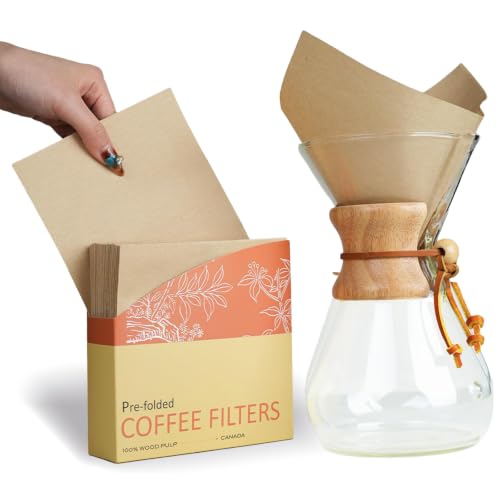
Convenient Pre-Folded Design: Enjoy the convenience of our pre-folded coffee filters designed to save you time without the hassle of folding. Just place, brew, and dispose for a no-fuss cleanup.

Conical shape ensures uniform extraction for pure coffee flavor.

Step 1: Fold the CHEMEX filter in half. Then fold in half again, bringing the two corners together. Place your finger between the 3rd and 4th layer and open into a funnel.
Fix the Most Common Folding Mistakes
Most of your Chemex troubles come from the fold itself—you’re either fighting the paper’s natural creases, using the wrong filter size, or folding it so tight it won’t stay open.
Here’s the thing: you need to respect the pre-existing seams. Folding against them creates filter integrity issues that sabotage your brew. Square filters need just two deliberate folds along those intended creases to form the cone properly.
Now, if you’ve folded too tightly, your filter won’t sit balanced inside the brewer. Use a chopstick to gently pry it open while maintaining the cone shape. Once you wet it with brewing temperature water, the paper relaxes and settles correctly.
Get the fold loose enough that the filter stays open naturally. The Aeropress method demonstrates how rapid, pressure‑assisted immersion can achieve a clean cup with low acidity. Proper brew temperature is crucial for extracting balanced flavors. Using an espresso‑grade grind can cause channeling and under‑extraction if the particles are too coarse.
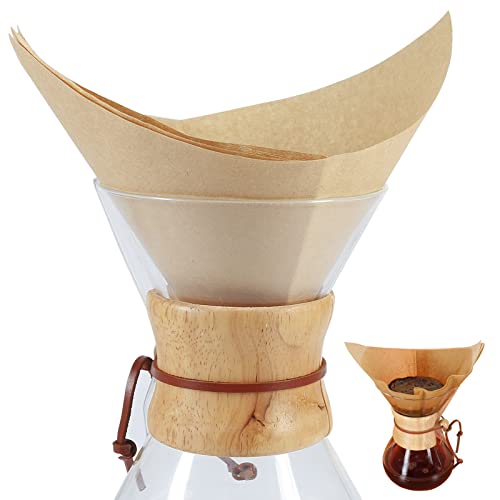
PREMIUM FOOD GRADE MATERIAL: Made of natural food grade wood pulp without fluorescence, unbleached, 100% safe for daily use.

QUANTITY & COLOR: Includes 100 white square coffee filters, providing a generous supply for daily brewing.

200PCS Value Pack for Everyday Brewing: Each box includes 200 pre-folded pour over coffee filters, providing a practical supply for daily coffee brewing. Ideal for home kitchens, office coffee stations, and anyone who enjoys fresh hand-brewed coffee