
You’re probably wondering why everyone talks about “30 lb” but you actually need only about 20‑25 lb (9‑11 kg) of steady, even pressure for a solid puck. Think of it like pressing a sandwich: once the bread is flat, extra force doesn’t make it tighter, it just risks crushing the filling. Aim for a firm, level tamp—about 20 lb—after a light pre‑press, and you’ll get consistent flow and richer crema; the next tip will show you how to fine‑tune grind and dose instead of adding more pressure.
What Is the Real Purpose of Tamping Espresso?
Why does tamping matter at all? You’re probably wondering why baristas obsess over a few seconds of pressure. Here’s the thing: tamping creates a uniform coffee puck so water meets the full surface evenly. That uniformity shapes puck dynamics, preventing weak spots where water would rush through and cause channeling. It also sets up proper pressure profiling, giving the machine’s 9‑bar pump enough resistance to extract flavors rather than just push water through.
All right, think of the puck like a sponge. When you compress it evenly, the water spreads like a gentle rain, soaking every grain. Uneven compression makes water find the path of least resistance, leaving under‑extracted zones. The result? A balanced shot with richer body and less bitterness.
Takeaway: Consistent, level tamping controls puck dynamics and pressure profiling, which are essential for a quality espresso. Next, you’ll want to explore how much force actually matters versus technique. Using a calibrated tamper to achieve 30‑35 psi ensures the optimal pressure range for a consistent extraction. A finer grind can enhance extraction consistency when combined with proper tamp pressure.
30 lb Myth vs. the Real Tamping Threshold
What’s the real pressure you need? You’re probably hearing the pound myth and wondering if 30 lb is a hard rule. Here’s the thing: the 30 lb target works more like a convenient benchmark, not a physics law. Studies show extraction stays the same from 10 lb up to 30 lb when the puck is level, so the threshold misconception that you must hit 30 lb is false. In practice, coffee density climbs sharply until about 20–25 lb, then extra force adds almost nothing. Below roughly 5–10 lb you risk air pockets and channeling.
All right, aim for a pressure that makes the puck feel solid and even—usually between 20 and 25 lb. Consistency beats chasing a specific number.
Takeaway: you don’t need a full 30 lb; you just need enough force to avoid under‑compaction. Next, ask yourself how you’ll keep that pressure consistent shot shot to shot. Using a consistent tamp helps maintain uniform extraction across pulls.
CHECK COMPATIBILITY: Espresso accessory works only with the following models; Bambino BES450, Bambino Plus BES500, Barista Express BES870, Barista Pro BES878, and Barista Touch BES880

CHECK COMPATIBILITY: This espresso accessory works only with the following models; Dual Boiler BES920, Oracle BES980, Oracle Touch BES990, Oracle Jet BES985, Oracle Dual Boiler BES995

A MUST HAVE PRESSURE GAUGE: Special design for coffee machine with E-61 grouphead, help you monitor the extraction of the coffee easily.
Why Consistent Tamping Espresso Beats Exact Poundage
If you’ve been obsessing over hitting exactly 30 lb, you’re not alone—many baristas think that number is the holy grail. The truth is, a steady tamping rhythm builds pressure memory far better than chasing a single pound figure. When you repeat the same force, the puck density stays uniform, so water meets consistent resistance and flow times stabilize. Why does repeatability matter? Small force shifts barely affect extraction compared to grind, dose, and distribution. A level tamp prevents channeling, while a consistent pressure eliminates one major source of shot‑to‑shot variation. Your taste buds will notice smoother, predictable espresso. Takeaway: Focus on a repeatable tamping rhythm and pressure memory, not an exact number. Next, ask yourself how to lock in that routine for every shot. Above 20 lb tamp pressures consistently yield stable extraction times. Proper pre‑infusion helps settle the grounds and further reduces channeling risk. The boiler temperature must stay within a narrow range to ensure the water extracts the coffee evenly.
Step‑by‑Step Tamping Espresso Technique for Repeatability
You’re probably wondering why your shots vary even when you think you’re doing everything right.
How do I set up the coffee bed before tamping?
First, weigh 18–20 g of coffee and spread it evenly with a distribution tool or gentle tapping. Break clumps with a WDT if needed. Level the surface, then hold the tamper like a doorknob, keeping your wrist straight and elbow over the wrist.
What pressure should I use?
Press down to about 30 lb (13–14 kg). A light 15 lb pre‑press helps seat the grounds, then finish with a firm, even tamp. Consistency matters more than raw force.
How do I guarantee puck consistency and pressure repeatability?
Follow the same sequence each time: dose, distribute, level, tamp, inspect. Keep your stance and hand position identical, and apply the same end‑point pressure. After tamping, check that the puck is flat, smooth, and undisturbed.
Takeaway: A repeatable workflow—steady stance, uniform pressure, and a level puck—delivers reliable extraction. Next, ask yourself whether you need to tweak grind, dose, or distribution before changing tamp pressure.
Using a flat‑bottom tamper helps ensure an even surface and prevents channeling.
A well‑maintained machine with proper water temperature is essential for consistent crema formation.
Regularly descale the machine to prevent mineral buildup that can affect temperature stability and extraction quality.
A consistent brew pressure ensures the water forces through the coffee evenly, promoting balanced flavor extraction.

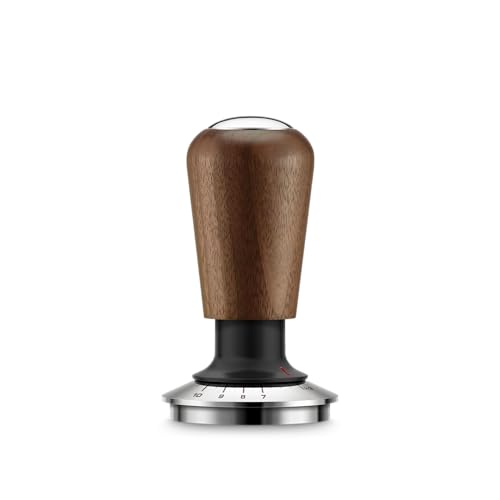
CONSISTENT PRESSURE EVERY TIME:Achieve perfectly even tamping with a built-in spring-loaded mechanism. Delivers consistent pressure without guesswork, reducing channeling and improving espresso extraction quality

51MM COFFEE TAMPER: This tamper is a good fit for 51mm portafilters.The flat metal base and wooden handle are ergonomically designed, allowing you to easily compact coffee powder.

Semi-Transparent Design - This coffee tamper hammer stands out with its unique semi transparent design. The semi transparent material allows every coffee tampering action to be within your line of sight. At the same time, the precise operation of the spring ensures even and stable coffee tampering force, adding a professional and meticulous touch to your coffee making. Whether for home or commercial use, this coffee tamper hammer can be your reliable assistant on your coffee journey
When to Tweak Espresso Grind, Dose, or Distribution Instead of Tamp Pressure
When you’re wondering why a tighter tamp isn’t fixing a sour shot, the answer is that grind, dose, and distribution matter far more.
When should you change grind size?
If the shot pulls too fast—under 25 seconds—go finer. If it drags past 30 seconds or the machine chokes, coarsen. A grind adjustment directly controls flow resistance, so you’ll see flavor shifts before any tamp tweak helps. The brew temperature also influences extraction balance, so keep it within the optimal range. Consistent grind uniformity ensures each particle extracts at the same rate, preventing uneven flavor.
When is dose consistency key?
Check that you’re hitting 16–20 g for your basket. Under‑dosing leaves headspace, over‑dosing crowds the shower screen and creates channeling. Keep the dose stable; small variations affect puck thickness more than a 5‑lb tamp change.
When does distribution trump tamp pressure?
Uneven grounds cause low‑density pathways even with a level puck. Use a distribution tool or gentle tapping to eliminate clumps. Once the coffee bed is uniform, a consistent tamp finishes the job.
Takeaway: Fix grind, dose, and distribution first; only then fine‑tune tamp pressure for repeatability.
Next step: measure your shot time and adjust grind before touching the tamper.

【Thinner 14 Needles】 Needles evenly distributed design. 7 food-grade stainless steel needles, 0.35mm diameter, the perfect size for breaking up coffee clumps, plus 7 replacement needles. Thoughtful needles storage tube. Say goodbye to the bent needles

【A Perfect Espresso Shot Companion】 Nessus espresso distributor includes 10 food-grade stainless steel needles with a 0.35mm diameter, which is the perfect size to break up coffee clumps. For added convenience, we provide an extra set of 10 needles in a storage tube. A good choice to add this espresso machine accessories to your coffee bar!

Even Espresso Extraction - This coffee stirrer uses 5 fine 0.4mm needles which help to distribute the coffee evenly in the filter when the barista is making the coffee to promote a more even extraction and better espresso. Eliminates clumping and improves consistency.
Typical Tamping Slip‑Ups and Quick Fixes
You’re probably wondering why your shots taste off even after you “just tamp harder.” The first slip‑up is an uneven or angled tamp. Keep the tamper base flush with the basket rim, align your wrist, elbow, and shoulder vertically, and lock the portafilter alignment before you press. A level countertop and a calibrated 58 mm tamper help you maintain a straight downward press, preventing channeling.
Now, double‑tamping ruins the bed you. A firm single tam builds muscle memory; avoid pressing again after you lift the tamper. Consistency beats raw force, so aim for the same pressure each shot—about 20–30 lb.
Here’s the thing: poor distribution leaves air pockets. Light tap or use a distribution tool to level the grounds before tamping; a uniform puck beats extra force every time.
All right, edge cleanup matters too. Choose a tamper that matches the basket, wipe the rim, and give a gentle twist after release—no re‑pressing. If grounds overflow, check basket capacity.
Takeaway: level tamp, single press, even distribution, and clean edges produce consistent extraction. Next, try a bathroom‑scale practice to lock in your pressure feel. Using a bottomless portafilter lets you see channeling instantly, helping you fine‑tune your tamp technique. Using a fine, consistent grind is essential for achieving proper extraction and crema when you only have pre‑ground coffee available. A proper water temperature of around 92‑96 °C ensures optimal solubility of coffee oils.