
You’re probably wondering why an AeroPress scoop doesn’t match a kitchen tablespoon, and that’s a good question. A level scoop holds about 2½ Tbsp, roughly 11.5 g of coffee, while a heaping scoop comes in at around 3 Tbsp (14‑15 g). The scoop’s shape is meant for quick dosing, not precision, so if you need exact ratios you’ll want a scale. Now you know the numbers, so you can tweak your brew strength or move on to grind‑size tips.
AeroPress Scoop vs. Tablespoon: The Quick Answer
Ever wonder exactly how many tablespoons your AeroPress scoop holds? You’re right to ask because the scoop material and shape affect measurement consistency. A level scoop delivers roughly 2.5 tablespoons, which matches the 11.5 g weight the brand cites. If you press the coffee down a bit, the heaping scoop bumps up to about 3 tablespoons, or 14–15 g.
Now, here’s the thing: most AeroPress guides treat the heaping scoop as the default dose, so you’ll see recipes start with “one heaping scoop per cup.” This consistency lets you swap the scoop for a measured tablespoon without guessing.
All right, takeaway: level = 2.5 Tbsp, heaping = 3 Tbsp. Next, decide if you’ll use a kitchen spoon for precision or stick with the built‑in scoop for convenience.
The Aeropress’s rapid pressure extraction also means a shorter brew time compared to the French Press.
optimal coffee‑to‑water ratio is essential for achieving the best flavor profile with any AeroPress method.
A proper brew temperature helps extract the balanced, aromatic cup every time.
Why an AeroPress Scoop Isn’t a True Tablespoon
If you’re wondering why the AeroPress scoop isn’t a true tablespoon, you’re on the right track. The scoop’s texture and shape prioritize quick dosing, not exact volume. A U.S. tablespoon holds about 14.8 mL, but the AeroPress scoop was built for convenience, not kitchen standards.
Here’s the thing: coffee density shifts with roast level and grind size. Fine grounds pack tighter, so the same scoop can hold more mass than coarse grounds. That means your brew consistency can drift even if you use the same “scoop count.” Consistent measurement is essential for repeatable flavor. All right, treat the scoop as an approximation, not a calibrated measure. Use the same scoop method each time, or weigh your coffee for true repeatability. The takeaway: the AeroPress scoop helps you brew fast, but it won’t guarantee a precise tablespoon conversion. Next, you might compare how many scoops equal 2½ tablespoons. The device’s compact design also makes it ideal for travel and on‑the‑go brewing. Standard scoop weight is typically around 7–8 grams, which is useful to know when calibrating your brew. Properly storing the coffee after grinding can preserve its flavor longer, especially when using a nitro infusion method for enhanced smoothness.
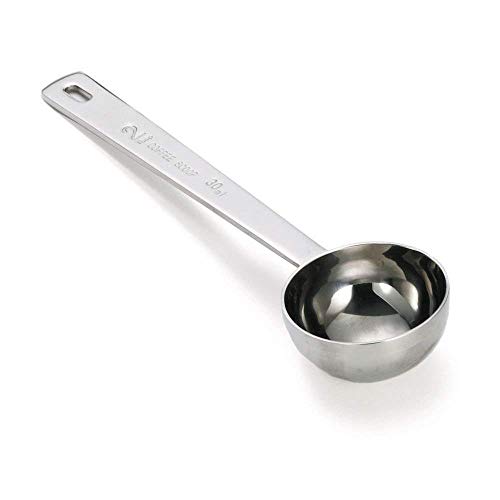
2 tablespoon coffee scoop: 30 ml capacity for measuring ground coffee, coffee beans, tea powder, sugar, baking powder, baking soda, spices, and condiments.

2 Pieces included

☕️ One-Handed Efficiency: The coffee scoop allows you to scoop, level, and fill reusable K Cups in one motion—perfect for busy mornings. No tool switching needed.
AeroPress Level Scoop ≈ 2½ Tablespoons (≈ 11.5 g)
You’re probably wondering exactly how many tablespoons a level AeroPress scoop holds, and the answer is simple: it’s roughly 2½ tablespoons, which translates to about 11.5 g of ground coffee.
What does “level” really mean?
Now, a level scoop sits flat on the rim, no heaping. This gives you a consistent volume that works as a quick‑brew unit. Because the scoop measures volume, grindsize consistency matters: a finer grind packs tighter, nudging the weight up a gram or two, while a coarser grind leaves a little air.
Why does grind variability matter?
Obviously, if you switch beans or adjust the grind, the 11.5 g figure shifts slightly. The level scoop isn’t a lab scale, but it’s reliable enough for everyday brewing when you don’t have a scale.
Takeaway
Use the level scoop as a convenient baseline, but aim for grindsize consistency to keep your coffee taste predictable. Next, you might explore how a heaping scoop changes the math.
A proper steeping time of 12–24 hours ensures optimal extraction for a smooth concentrate. Understanding tamping pressure helps achieve even extraction across the puck. Regular descaling prevents mineral buildup that could affect the scoop’s accuracy.

1. Precision Leveling & Funnel 2-in-1 Design Tired of messy coffee grounds or inaccurate measurements? Our scoop features an integrated leveler that slides to remove excess coffee, ensuring exactly 2 Tbsp every time. Flip it over—the scoop becomes a no-spill funnel that fits perfectly into reusable K-cup pods. No waste, no counter clutter, just a clean fill.

Coffee Scoop with Leveling Funnel: Our coffee scoop features a leveling funnel design for easily measure up to 2 tablespoons, making it easy to refill reusable K-cup pods

Durable and attractive stainless steel construction for longevity
AeroPress Heaping Scoop ≈ 3 Tablespoons (≈ 14‑15 g)
How much coffee does a heaping AeroPress scoop hold? You’re probably wondering if “heaping” means a vague mountain of beans or a reliable measure. Here’s the thing: the AeroPress heaping scoop rounds to about three tablespoons, which translates to roughly 14‑15 g of coffee. Scoop density matters—if you press the scoop down, you pack more beans, nudging the weight up a gram or two. Grind consistency also plays a role; a medium‑fine grind settles differently than a coarse grind, so the volume can shift slightly.
All right, think of it like a kitchen measuring cup: you get a quick, repeatable estimate without a scale, but a scale still wins for precision.
Takeaway: a heaping scoop ≈ 3 Tbsp ≈ 14‑15 g, but watch scoop density and grind consistency for best results. Next, you might ask how to translate that into brew ratios.
A standard coffee scoop typically holds about 1 to 1½ tablespoons (approximately 15–22 ml) of ground coffee.
proper tamptemperature is essential for extracting the full flavor profile of the beans.
Espresso‑Style Coffee in a French Press requires high pressure to achieve authentic espresso extraction.

Compact Travel Coffee System – Brew smooth, rich coffee anywhere in under 2 minutes. Includes a small, portable version of our 3-in-1 brewer and a lightweight, microwaveable mug with a silicone lid. Just unpack, brew and repack the coffee press back into the custom mug that doubles as a portable, travel container. Make hot or iced coffee on the go— traveling, camping, backpacking, hiking, and boating.

Clear Colors in Shatterproof Tritan – AeroPress Clear Black Coffee Press features our iconic 3 in 1 brew tech in crystal clear Tritan for a durable, shatterproof, travel-ready brewer that lets you see your brew – wherever your brew takes you.

[Not just make it, we upgrade it.] We are a professional kitchenware producer who have been focus on customer experience. In order to offer better kitchenware, U-Taste collects customer suggestions of all similar products on Amazon. And then upgrade the products based on the data of the bad evaluation with the aim to provide customers with better kitchenware products.
AeroPress Brew Ratios: Quick Scoop‑to‑Weight Cheat Sheet
You’ve just figured out that a heaping AeroPress scoop is roughly three tablespoons, about 14‑15 g of coffee. Now you wonder how that translates into brew ratios. Here’s the thing: a level scoop (≈ 11.5 g) paired with 240 g water gives a 1:16 ratio, a balanced cup with smooth flavor and moderate strength. If you want a bolder taste, increase coffee to 30 g (two heaping scoops) and keep water at 240 g for a 1:8 ratio; finer grind and longer brew time boost extraction and concentration. For an ultra‑strong shot, try 36 g coffee to 240 g water (1:6) and dilute later to tame intensity while preserving aroma. Takeaway: Use the scoop‑to‑weight chart to set coffee, then adjust water, grind, and time for your desired strength and balance. Next, experiment with a single variable—either coffee dose or water volume—to lock in consistency and repeatability. Cold brew offers a smooth, low‑acid flavor that can be a great base for experimenting with AeroPress ratios. The extraction control of the Aeropress allows fine‑tuning of flavor intensity through pressure and brew time adjustments. Using unbleached paper towels as a temporary filter can affect coffee clarity and flavor.