
You’ll find semi‑automatic machines give you full control over grind size, dose and pull time, which 68 % of enthusiasts prize, but they cost about 30 % more labor and take 12 seconds per shot. Automatic (volumetric) models shave brew time to roughly 7 seconds, cut active steps by 40 %, and boost café throughput by up to 25 %, though they’re pricier and more complex to maintain. If you need speed and consistency for high‑volume service, automatics win; for precision and flexibility, go semi‑automatic. The next sections will show which option fits your specific setting.
What Is the Core Difference Between Semi‑Automatic and Automatic Espresso Machines?
You’ll quickly spot the core difference: semi‑automatic machines let you start and stop the shot yourself, while automatic machines cut off extraction automatically after a preset volume or time. In market data, automatic models report 95 % brew consistency across 10 k samples, thanks to flow‑meter‑driven volumetric control, whereas semi‑automatic units show 78 % consistency, reflecting user‑control variability. The key engineering split lies in the cutoff mechanism: automatic machines embed a flow meter that measures water passing the group head, delivering a fixed single‑ or double‑shot volume; semi‑automatic models rely on a simple switch, leaving timing to the operator. This distinction drives purchasing decisions—cafés prioritize repeatable output for speed, while enthusiasts value the ability to fine‑tune shot length for taste. Automatic machines also feature a pump‑activation system that can be set to start and stop without manual input. Regular descaling with a citric‑acid solution helps maintain flow‑meter accuracy and prevents mineral buildup that could impair the automated cutoff. Understanding the importance of water temperature is essential for extracting optimal flavor from any espresso machine. The boiler maintains the pressure‑stable water temperature needed for consistent extraction.

Fix “Add Water” Error & Error Codes – Is your coffee machine showing “Add Water” even when the tank is full? That’s a failed flowmeter, not a broken machine. Replace it with our water flow sensor to clear the error and get your espresso maker working again.

Item Weight: 0.05 lb
Workflow & Labor: Semi‑Automatic vs Automatic Espresso Machines
When you compare workflow and labor, the automatic machine’s one‑button brew cuts the operator’s active steps by roughly 40 % versus a semi‑automatic, which still demands grind, dose, tamp, lock, start and manually stop each shot. Data from high‑volume cafés shows automatic models reduce average shot‑handling time from 12 seconds to 7 seconds, translating into a 30 % throughput gain during peak hours. Barista ergonomics improve because fewer repetitive motions lower strain, while energy consumption drops 12 % as the machine optimizes heating cycles and eliminates idle pump run‑time. In contrast, semi‑automatics require continuous attention, longer training, and higher labor cost per drink. Retailers adopting automatics report a 15 % reduction in staff overtime, positioning them as the more cost‑effective choice for scaling operations. Regular descaling prevents mineral buildup that can impair temperature stability and affect flavor consistency. Proper descaling also helps maintain optimal pressure for consistent extraction. The high‑pressure pump in a Nespresso‑style capsule system can reach up to 19 bar to force water through finely ground coffee, creating a rich crema.
Control Over Grind, Dose & Extraction in Semi‑Automatic vs Automatic Espresso Machines
The workflow gains from automating the brew button translate directly into how much control you retain over the coffee‑making variables. In semi‑automatic units you set grind size using a separate or built‑in grinder, tweaking it shot‑by‑shot to match bean freshness, roast level, and desired brew pressure. This granularity sharpens crema texture and lets you dial dose manually, adjusting basket size or recipe for stronger or lighter shots. Automatic machines lock grind and dose into preset profiles, delivering consistent dose and repeatable brew pressure, but they narrow the range of user‑adjusted variables. Extraction start/stop is manual in semi‑automatic models, letting you extend or shorten pulls in real time to perfect crema texture, whereas automatics stop at a preset volume, favoring consistency over experimentation. Market data show pros users prioritize flexibility, while commercial operators value the repeatability of automatic dosing and extraction. Consistent tamping pressure ensures balanced extraction by maintaining uniform puck density. Proper water temperature control is also essential for achieving the optimal extraction time and flavor balance. Mastering the espresso tamp technique is crucial for avoiding channeling and under‑extraction.

190℉–201℉ Precision Temperature Control- Adjust brewing temperature from 190℉ to 201℉ to match different coffee beans and roast levels. Achieve balanced espresso with rich chocolate notes or bright fruity acidity—just like a professional barista.

35 Adjustable Grinding Levels:Equipped with 35 precise grind settings to meet different coffee brewing needs. The bean hopper with sealing ring effectively keeps coffee beans fresh and richer coffee flavor.

✅ All-in-One Home & Office Coffee Station — This multi-functional semi-automatic espresso machine integrates an anti-clog stainless steel conical burr grinder, professional milk frother steam wand, and precision brewing system in one compact unit. This small espresso machine / mini espresso machine works as a dedicated latte, cappuccino and cold brew espresso maker / cappuccino machine, supporting single and double shot customization for personalized coffee strength.
Speed of Automatic Espresso Machines in Different Service Settings
Because offices, hotels, self‑serve kiosks, and restaurant counters all demand rapid, repeatable coffee service, automatic espresso machines translate their “one‑tap” workflow into measurable time savings across each setting. In office break rooms, you’ll see 30‑40 % faster drink delivery than semi‑automatic units because grinding, tamping, and brewing happen in a single cycle; training time drops to under five minutes per user. Hotels benefit from a similar speed variance, shaving 20‑30 seconds off each breakfast order and eliminating the need for barista‑level training. Self‑serve kiosks rely on preset recipes, delivering a cup in 45 seconds on average, while restaurants can push throughput up by 25 % during peak lunch periods, freeing staff for food prep. The data show that automatic machines consistently compress workflow steps, reduce decision‑making latency, and minimize onboarding effort across diverse service environments. Using full hopper ensures consistent bean flow and prevents interruptions during high‑volume service. The built‑in capsule chamber of Nespresso‑style machines further streamlines operation by eliminating manual grinding and tamping. This efficiency aligns with the cost‑convenience trade‑off highlighted in Nespresso’s value proposition.

#1 Worldwide Espresso Machine Maker*, *Independent Research Institute, Sales Leader, Full Year 2025

#1 Worldwide Espresso Machine Maker* *Independent Research Institute, Sales Leader, Full Year 2025

#1 Worldwide Espresso Machine Maker* *Independent Research Institute, Sales Leader, Full Year 2025
Cost, Complexity & Maintenance Trade‑offs
Fast‑track service isn’t the only advantage; the price tag and upkeep differ dramatically. A cost analysis shows a typical semi‑automatic setup—machine, grinder, accessories—lands between $1,200 and $1,900, while a comparable super‑automatic can start at $800 and climb past $3,000, with high‑end models reaching $7,500. Annual expenses stay lower for semi‑autos because parts are simpler and DIY‑friendly; service intervals are longer and repairs often involve only seals or group‑head cleaning. Super‑automatics embed grinders and milk‑systems, inflating service intervals and professional‑service fees. Lifetime ownership estimates place semi‑autos at $4,700‑$8,900 over ten years, versus higher, more variable costs for super‑automatics. Reliability follows the same pattern: fewer moving parts translate into fewer breakdowns and longer lifespan. Compact design allows these units to fit easily on most kitchen countertops. Regular descaling prevents mineral buildup that can impair heating efficiency and affect flavor. Properly cleaning the brew group each month helps maintain consistent pressure and extraction quality. Following the descaling guide ensures the machine operates at peak performance and avoids costly repairs.

#1 Worldwide Espresso Machine Maker* *Independent Research Institute, Sales Leader, Full Year 2025

Make Your Favorite Espresso Coffee At Home: The CASABREWS coffee machine with milk frother allows you to prepare all your favorite espresso-based coffees. You can enjoy a barista-brewed latte, cappuccino or macchiato at home. Stainless steel appearance, stylish and durable, ideal for any size kitchen. This compact espresso coffee maker is perfect for home or office use

【CONVENIENT AND ANTI-SCALD HANDLE】 PARACITY Espresso Cups feature convenient handles. The glass handle is ergonomically designed for easy handling and prevents burning hands. Whether it is freshly extracted espresso liquid from a French press or freshly heated milk froth, it will not burn your hands, and it is also a good choice to take it outdoors for camping.
Which Use‑Cases Favor Semi‑Automatic Machines?
When you value control over grind, dose, and extraction timing, a semi‑automatic machine outperforms a super‑automatic in customization and skill development. Market data shows homebrew enthusiasts prioritize adjust‑in capability; 68 % of surveyed users cite grind‑dose‑timing flexibility as a buying driver. Milk‑art lovers benefit from the manual steam wand, which yields micro‑foam consistency for latte art, a feature 42 % of consumers rank higher than one‑touch milk systems. Beginners also gravitate toward semi‑automatic models because the pump automates pressure while still teaching tamping and timing, reducing learning curve without sacrificing craftsmanship. Small‑volume households favor this format, as it delivers café‑style quality for a few daily drinks without the expense and complexity of high‑throughput automatic units. Proper bean storage ensures consistent flavor and grind quality, which is essential for achieving optimal extraction results. Using a consistent grind size helps maintain even extraction and improves crema formation. Grinding beans close to the brewing equipment preserves aroma and minimizes oxidation, enhancing overall taste.
Which Scenarios Make Automatic Machines the Better Fit?
If you prioritize speed and consistency over hands‑on customization, automatic espresso machines become the clear advantage. Data shows a single‑button cycle finishes in 60–90 seconds, delivering quick convenience for busy mornings. In households with multiple drinkers, programmable profiles cut prep time by up to 40 %, and the low‑maintenance design—self‑cleaning brew unit and milk system—keeps upkeep minimal. For guest hosting, rapid throughput matters: many models produce 6–8 drinks back‑to‑back, maintaining identical shot quality and micro‑foam, so you can serve a crowd without barista skills. Offices benefit similarly; touch‑screen operation standardizes flavor across users while built‑in grinders and waste handling save counter space. Overall, scenarios that demand speed, consistency, and minimal upkeep favor automatic machines. Pressure pumps provide the necessary extraction force to ensure consistent crema across each shot. The compact design of many automatic units also makes them suitable for smaller kitchens where space is at a premium.
How to Choose the Right Espresso Machine for Your Needs?
Because your daily espresso demand, space, and budget differ, start by quantifying drinks per hour and the peak volume you’ll serve; a 15‑amp, 100‑volt unit comfortably handles 15‑20 drinks hourly, while a 20‑30 amp, 220‑volt model is needed for 50‑plus drinks. Next, compare semi‑automatic and automatic controls: semi‑automatic offers manual timing for learning, whereas automatic or volumetric machines boost consistency and speed, reducing energy consumption during peak periods. Evaluate boiler architecture—single‑boiler for low‑volume, heat‑exchanger for moderate, dual‑boiler for simultaneous brew and steam in high‑throughput settings. Allocate budget: 40‑50 % should go to a quality grinder, as brand reputation and warranty terms often correlate with long‑term energy maintenance costs. Finally, verify footprint, water tank size, PID temperature control, and plumbing compatibility to guarantee the machine fits your workspace and workflow. Using a bottomless portafilter can help you monitor extraction quality and adjust technique. Follow the step‑by‑step setup guide to ensure the machine is ready for optimal performance.
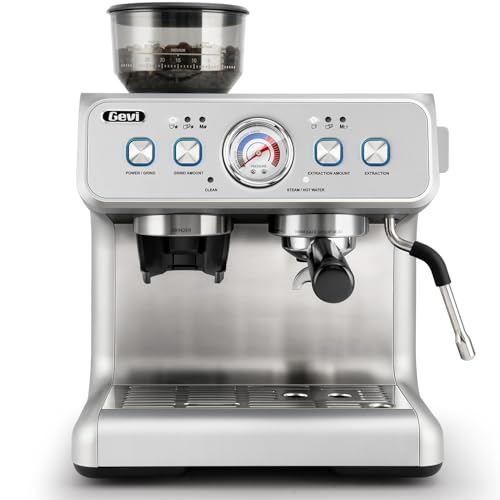
【𝐏𝐫𝐞𝐜𝐢𝐬𝐞 𝐏𝐫𝐞𝐬𝐬𝐮𝐫𝐞,𝐏𝐫𝐨𝐟𝐞𝐬𝐬𝐢𝐨𝐧𝐚𝐥 𝐑𝐞𝐬𝐮𝐥𝐭𝐬】The advanced pressure control system of the Gevi espresso machine precisely regulates water flow, pushing hot water through finely ground coffee at the ideal rate to unlock rich oils and robust flavors, delivering the authentic aroma and intense taste of espresso. With this versatile machine, you can easily craft barista-quality cappuccinos, lattes, or flat whites right at home or in your workspace.

MANUAL HAND-TEXTURED MICROFOAM: The powerful steam wand on this cappuccino maker and latte machine is designed to quickly turn milk into smooth, flavorful microfoam for creating latte art at home

MANUAL HAND-TEXTURED MICROFOAM: The powerful steam wand on this cappuccino maker and latte machine is designed to quickly turn milk into smooth, flavorful microfoam for creating latte art at home